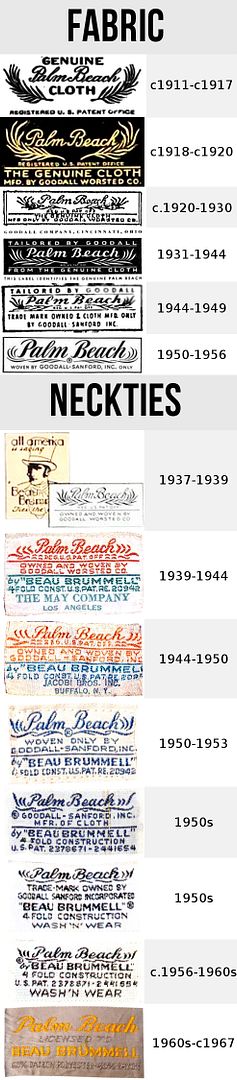
As with all other guides for dating vintage clothes, always use a variety of methods when attempting to assess a garment’s date of manufacture. While there is a fairly continuous base of ads and dated examples to draw upon, with changes of labels, there is always overlap of the old and the new. And as with anything else, there are usually a variety of variations (the Palm Beach Beau Brummell ties spring to mind) for any basic pattern of label, which can cause confusion.
History
Goodall Mills of Sanford, Maine was founded in 1847. They introduced Palm Beach cloth in 1911. The iconic white variety of the fabric was immediately adopted in the South, but took some time to catch on in Northern states. By 1923, Palm Beach cloth was being produced in more than 140 colors and patterns. (source) Darker colors proved more popular with Northerners who wanted the cool fabric without attracting undesired sartorial attention. Within the first decade of production, soundalike imitation fabrics had started to pop up and “Palm Beach” had become the layman’s term for a light colored suit.
In 1931, a second plant opened in Cincinnati, and the company headquarters relocated to that city. In that same year, the Goodall Worsted Co. organized the Goodall Co., Inc. to “manufacture all garments made of Palm Beach cloth for the 1932 season”. (source) Up until that point, the quality and cost of suits made of Palm Beach cloth had varied wildly. That plant was bought out in 1942, and retooled for the war effort. Despite this, the company headquarters remained in Cincinnati. With control over the fabric and tailoring, Goodall Mills began opening their own line of Palm Beach stores, to sell direct to the public. (source)
In 1944, the town name, “Sanford” was added to the mill name “Goodall”. By the 1940s, further plants producing Palm Beach Cloth had opened in Boston. (source) In 1949, the clothing branch of Goodall Sanford was renamed to simply the “Palm Beach Company”.
The Maine operation of Goodall-Sanford announced losses in 1949. They began to transfer some cloth production to Cincinnati in 1952. (source)Losses were announced again in 1952, though by 1953, sales were back up. Competitor Burlington Mills bought controlling interest in the Goodall Sanford mills in July of 1954, with the plans of “divesting itself of the cutting (suitmaking) operation”. (source) By November of 1954, Goodall-Sanford sold all four of its fabric mills in Maine, leasing one back with the intention of continuing production of Palm Beach fabric. (source) The suitmaking side of the company and the Palm Beach name (but not the mill) was sold in 1955 to Elmer L. Ward, long time president of the Goodall Sanford company. Palm Beach cloth continued to be produced and advertised through until 1956. In the face of dwindling profits, Burlington Mills (later Burlington Industries) shut down the production of Palm Beach Cloth.(source)
Elmer L. Ward retained control of the “Palm Beach” company until 1979, when he was succeeded by his son, Lawrence Ward. It took nine years to pay off the debt accrued by the company prior to the buyout, but under Ward, Palm Beach went public in 1965. In 1975, the holding company “Palm Beach Inc.” was created, which expanded to include the brands of Varsity Town, Gant, Austin Hill, Evan Picone, John Weitz, Calvin children’s wear, Eagle shirts, Haspel, and Country Set. Elmer Ward passed away in 1982. In 1985, a 62% controlling interest was bought out by Merrill Lynch Capital Markets. In 1988, the Palm Beach name was sold again, to Southport, Connecticut based “Crystal Brands”. (source) The name was re-sold to HMX LLC. In 2010, the Palm Beach brand was merged into the “Austin Reed” name.(source)A year later, HMX re-launched the brand. (source)
Content
The fabric content of Palm Beach Cloth changed a number of times of the course of its production.
1912 – Cotton Warp, Mohair Weft
1941 – Reformulated to make the fabric softer and lighter. Precise content unknown, but likely included the addition of Rayon.
Late 1940s – Cotton, Mohair, Rayon. The precise content depended on the fabric’s application, and the region of the country in which it was sold. For instance, the fabric in a Palm Beach necktie of this era was 50% Rayon – 32% Mohair – 12% Cotton – 6% Nylon.
Pricing
The prices for Palm Beach suits varied wildly up until 1931. Up until that point, Goodall Sanford supplied their Palm Beach Cloth to a variety of tailors who produced suits of varying quality and prices. After 1931, clothing made from Palm Beach cloth was made in-house.
A Palm Beach cloth suit sold for $18.50 in 1934
A Palm Beach cloth suit sold for $15.75 in 1935
A Palm Beach cloth suit sold for $15.75 in 1936
A Palm Beach cloth suit sold for $16.75 in 1937
A Palm Beach cloth suit sold for $17.75 in 1938
A Palm Beach cloth suit sold for $15.50 in 1939
A Palm Beach cloth suit sold for $19.50 in 1942
A Palm Beach cloth suit sold for $19.50 in 1945
A Palm Beach cloth suit sold for $23.50 in 1947
A Palm Beach cloth suit sold for $26.75 in 1948.
A Palm Beach cloth suit sold for $27.50 in 1949.
Neckties
In ’31, The Goodall mills switched over to tailoring all their own products for the most part, and gave the contract to produce neckties to Cohn, Roth & Stiffsen of New York, Franc, Strohmenger & Cowan of New York, and Hewes & Potter of Boston. None produced ties from Palm Beach Cloth in any notable quantity. (source) Cluett Peabody (Arrow Ties) had rejected the fabric.
A 1936 contract with the Weisbaum Bros., Brower Company, Cincinnati (producers of Beau Brummell neckties) gave them the exclusive right to produce Palm Beach Cloth neckties.
Patents found on Palm Beach neckties
RE20942. Issued 1938
2131545. Issued 1938
2378671. Issued 1945.
2441654. Issued 1948.
1940s composition: 53% mohair, 47% cotton
Early ’50s composition, from your tag: 50% Rayon, 32% mohair, 13% cotton, 5% nylon.
I’ve seen another from that era marked 50% Rayon, 32% Mohair, 12% Cotton, 6% Nylon.
It looks like by the ’50s “Wash and Wear” Palm Beach ties by Beau Brummel had been re-formulated again to be:
55% dacron polyester, 40% Rayon, and 5% Polyester. I’m seeing ads for those in the late 1950s. Oddly, the tags still say “woven only by Goodall Sanford”, despite the name “Palm Beach” and the Goodall Sanford mills splitting ways around 1955. It was sort of a gradual split, ’54-’56. In the early ’50s, some of the fabric production had moved from Maine to Ohio. I wonder if that included the fabric used in their neckties?
By the ’60s, Beau Brummell Palm Beach ties were 60% polyester, 40% rayon


 Vintage-Haberdashers Blog