1910s / 1920s Filson canvas jacket

This vintage jacket was made by the C.C. Filson company of Seattle, Washington in the 1910s or early 1920s. It is in remarkably good condition- the best I’ve seen. The label bears their early 1011 First Avenue address. By 1924, Filson had re-located down the block to 1005 First Ave, then again in 1930 to 1001 2nd ave, updating their label accordingly each move. This conclusively dates from the 1910s or early 1920s. The label is of the early style, reading, “C.C. Filson Co / 1011 1st Ave / Seattle Wash / Manufacturers / Complete Outfitters / For Miners, Prospectors, Lumbermen”. At this time, Seattle was still the jumping-off-point for Alaska, and Filson advertised themselves as a “Complete Alaska Outfitter”. Later on, the “Might As Well Have The Best” slogan would come into usage.

The jacket is a heavy dry tin-cloth canvas. It has half-moon pockets on the front, leading to an internal unlined game-bag. Flaps on the back lead to this pocket as well. This creates a double thickness of high quality canvas throughout the coat, making for a durable garment. The collar is corduroy, and has a matching corduroy throat latch / chin strap. The shoulders are reinforced against wear when carrying loads. The hip pockets are of the early double-round style, and share a common pocket flap. The main breast pocket is similarly enormous, with a more regularly sized pocket overtop. The underarms have football gussets for a greater range of motion. The cuffs are lined with wool, and close with United Carr snaps. The snaps, both on the cuffs and the breast pocket, are of the early printed type, and still are very clear.

Chest (pit to pit): 21″
Shoulder to Shoulder: 17-1/2″
Sleeve (Shoulder to cuff): 24″
Length: 29″

 photo IMG_0002.jpg

 photo IMG_0006-1.jpg

 photo IMG_0072.jpg

 photo IMG_0074.jpg

 photo IMG_0011-1.jpg

 photo IMG_0013-1.jpg

 photo IMG_0016-1.jpg

 photo IMG_0017.jpg

 photo IMG_0014-1.jpg

 photo IMG_0015.jpg

 photo IMG_0002-Copy.jpg

Address up until 1923.  photo 1922.jpeg

1920s DuxBak hunting vest

http://www.ebay.com/itm/281160337309
This vintage hunting vest was made in the 1920s. The DuxBak line was started in 1906 by Bird, Jones and Kenyon, and had a factory located at 1 Blandina St., Utica, NY. Prior to the 1920s, Duxbak used the slogan “Duxbak Sportsman’s Clothing” in their advertisements and on their tags. During the 1920s, they switched to ” Duxbak Rain Proof Sportsman’s Clothing”. By the 1930s, they had changed their label to include a graphic of a hunter, and to emphasize “Utica”.

This shell vest design changed very little from when it was introduced in the early 1900s until this one was produced. As it was a garment of pure function, it was not beholden to the whims of fashion. A good design was a good design, and they stuck with it. It has loops for 28 shotgun shells, a high buttoning neckline to protect the wearer from the elements, and a buckle back to adjust for a comfortable fit. The buckle used on the back bears the patent number “819180”, which shows that this buckle design dates from 1906. The vest has a six button front, and all the buttons bear the DuxBak name.

Tagged Size:
Chest (pit to pit): 18-3/4″ (doubled = 37.5″)
Length (neck to hem down back):18″

 photo IMG_0003.jpg

 photo IMG_0012.jpg

 photo IMG_0011.jpg

 photo IMG_0006.jpg

 photo IMG_0007.jpg

 photo IMG_0008.jpg

 photo IMG_0010.jpg

 photo IMG_0013.jpg

 photo IMG_0014.jpg

 photo IMG_0017.jpg

 photo US819180-0.jpg

 photo invoice.jpg

 photo 190405.jpeg

 photo 190601Stitch.jpg

 photo 190801.jpeg

1920s wool outdoors shirt

http://www.ebay.com/itm/271246671831
This vintage shirt was made in the 1920s or 1930s. It is similar to the army shirts of WWI, with its pullover styling and attached collar, but does not have the breast pockets of that pattern. The buttons on the cuffs are mis-matched, but are obviously very old replacements.

Chest (pit to pit): 20″
Shoulder to shoulder: 16″
Sleeve (shoulder to cuff): 21″
Collar: 15″

 photo IMG_0001.jpg

 photo IMG_0005.jpg

 photo IMG_0006.jpg

 photo IMG_0007.jpg

1910s summer vest

http://www.ebay.com/itm/271245474316
This vintage vest was made in the 1910s. It has an incredible weave, be sure to see the close up photo. It has five mother of pearl buttons and a belted back. There are repairs around the buttons, and staining throughout the vest. The belt is missing its buckle, and is pinned up for the photos.

Chest (pit to pit): 20-1/2″ (doubled = 41″)

 photo IMG_5652.jpg

 photo IMG_5655.jpg

 photo IMG_5657.jpg

 photo IMG_5658.jpg

1920s Stetson raw edge homburg

http://www.ebay.com/itm/271221600245
This vintage hat was made in the early 1920s by the John B. Stetson company. It is an interesting transitional style. At the time this was sold, it probably would have been designated as a fedora style – at that point, “fedora” had a broader definition. It has a curled edge brim- the same curl used on Boss Raw Edge westerns of the period – this is the first I’ve seen it on a dress hat like this. With the proportions it has, and its curled brim, today it would be called a homburg or a “Lords Hat”. It has a wide ribbon with a frayed-edge bow. The frayed trailing edge was a popular styling cue on hats of this era. Inside, the hat is unlined. The sweatband stampings indicate that it is a “Select Quality” felt, which sold for $7 in the early 1920s. This made it an expensive hat for the time period. It was sold in Jackson, TN by the G.H. Robertson Co.
Size: 7-1/4
Brim Width: 2-3/4″
Crown Height: 5-1/2″
Ribbon Width: 2-1/8″

 photo IMG_0024.jpg

 photo IMG_0025.jpg

 photo IMG_0026.jpg

 photo IMG_0027.jpg

 photo IMG_0028.jpg

 photo IMG_0029.jpg

 photo IMG_0032.jpg

 photo IMG_0033.jpg

 photo IMG_0034.jpg

 photo IMG_0038.jpg

 photo IMG_0039.jpg

 photo IMG_0040.jpg

 photo IMG_0041.jpg

 photo IMG_0042.jpg

1910s Stetson overwelt homburg

http://www.ebay.com/itm/281120385608

This vintage Stetson was made in the 1910s. It is a medium brown fur felt, in a transitional style somewhere between a fedora and a homburg. It has an overwelt brim edge (typical of fedoras), but with a more typically homburg style flange to the brim. There is a wide brown grosgrain ribbon. The trailing edge of the bow has a frayed edge, as was the style of the day.
Inside, the hat has a dark rose colored lining, with gold colored piping, and a detailed “Gold Medal” style imprint. The sweatband is a creamy beige, with a gold embossed Stetson logo, touting their gold medal victories in 1876, 1878, 1889 and 1900. The hat has premier quality felt. It was sold by Jos. Polczynski hatters, 9307 Jos Campau, near Holbrook, Hamtramck, MI. This would later become Henry the Hatter.

Size: 7
Brim Width: 2-3/8″
Crown Height: 5-1/2″
Ribbon Width: 2″
 photo IMG_0044.jpg

 photo IMG_0045.jpg

 photo IMG_0046.jpg

 photo IMG_0047.jpg

 photo IMG_0048.jpg

 photo IMG_0051.jpg

 photo IMG_0053.jpg

 photo IMG_0054.jpg

 photo IMG_0055.jpg

 photo IMG_0056.jpg

1910s Stetson velour fedora hat

http://www.ebay.com/itm/271206289096

This vintage hat was made in the 1920s by the John B. Stetson company. It is made of a luxuriant fur felt velour. It has a raw edge brim, flanged somewhere in-between what we now think of as a fedora, and a homburg. It has a twisted bow with an intentionally frayed trailing edge, a popular detail at that time. It was originally sold by the Marshall Field Company. The sweatband bears their stamp, but not the Stetson mark. The back of the leather shows Stetson’s stamp, Lot 5992, which places the sweatband in somewhere in the early 1920s timeframe. There are signs of stitching from an unreeded sweatband, which would indicate that this early 1920s sweatband is a replacement, and that the hat itself was made prior to WWI.
The felt is in very good shape, as is the sweatband.

Size: 7-1/4
Brim Width: 2-5/8″
Crown Height:
Ribbon Width:

 photo IMG_1726-1.jpg
 photo IMG_1727.jpg
 photo IMG_1728-1.jpg
 photo IMG_1729-1.jpg
 photo IMG_1731.jpg
 photo IMG_1732-1.jpg
 photo IMG_1733-1.jpg
 photo IMG_1734.jpg
 photo IMG_1735-1.jpg

Palm Beach Cloth

As with all other guides for dating vintage clothes, always use a variety of methods when attempting to assess a garment’s date of manufacture. While there is a fairly continuous base of ads and dated examples to draw upon, with changes of labels, there is always overlap of the old and the new. And as with anything else, there are usually a variety of variations (the Palm Beach Beau Brummell ties spring to mind) for any basic pattern of label, which can cause confusion.
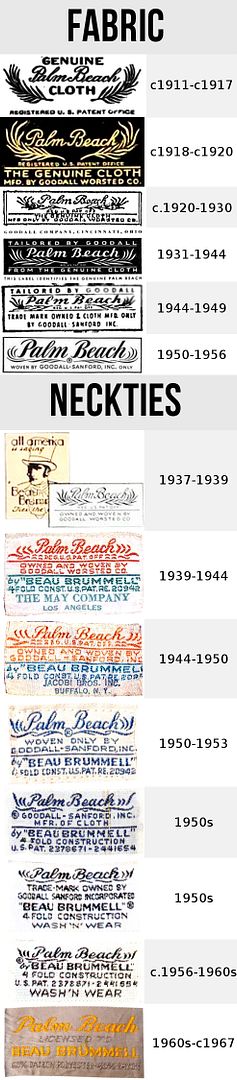
 photo guide.jpg

History

Goodall Mills of Sanford, Maine was founded in 1847. They introduced Palm Beach cloth in 1911. The iconic white variety of the fabric was immediately adopted in the South, but took some time to catch on in Northern states. By 1923, Palm Beach cloth was being produced in more than 140 colors and patterns. (source) Darker colors proved more popular with Northerners who wanted the cool fabric without attracting undesired sartorial attention. Within the first decade of production, soundalike imitation fabrics had started to pop up and “Palm Beach” had become the layman’s term for a light colored suit.

In 1931, a second plant opened in Cincinnati, and the company headquarters relocated to that city. In that same year, the Goodall Worsted Co. organized the Goodall Co., Inc. to “manufacture all garments made of Palm Beach cloth for the 1932 season”. (source) Up until that point, the quality and cost of suits made of Palm Beach cloth had varied wildly. That plant was bought out in 1942, and retooled for the war effort. Despite this, the company headquarters remained in Cincinnati. With control over the fabric and tailoring, Goodall Mills began opening their own line of Palm Beach stores, to sell direct to the public. (source)
In 1944, the town name, “Sanford” was added to the mill name “Goodall”. By the 1940s, further plants producing Palm Beach Cloth had opened in Boston. (source) In 1949, the clothing branch of Goodall Sanford was renamed to simply the “Palm Beach Company”.

The Maine operation of Goodall-Sanford announced losses in 1949. They began to transfer some cloth production to Cincinnati in 1952. (source)Losses were announced again in 1952, though by 1953, sales were back up. Competitor Burlington Mills bought controlling interest in the Goodall Sanford mills in July of 1954, with the plans of “divesting itself of the cutting (suitmaking) operation”. (source) By November of 1954, Goodall-Sanford sold all four of its fabric mills in Maine, leasing one back with the intention of continuing production of Palm Beach fabric. (source) The suitmaking side of the company and the Palm Beach name (but not the mill) was sold in 1955 to Elmer L. Ward, long time president of the Goodall Sanford company. Palm Beach cloth continued to be produced and advertised through until 1956. In the face of dwindling profits, Burlington Mills (later Burlington Industries) shut down the production of Palm Beach Cloth.(source)

Elmer L. Ward retained control of the “Palm Beach” company until 1979, when he was succeeded by his son, Lawrence Ward. It took nine years to pay off the debt accrued by the company prior to the buyout, but under Ward, Palm Beach went public in 1965. In 1975, the holding company “Palm Beach Inc.” was created, which expanded to include the brands of Varsity Town, Gant, Austin Hill, Evan Picone, John Weitz, Calvin children’s wear, Eagle shirts, Haspel, and Country Set. Elmer Ward passed away in 1982. In 1985, a 62% controlling interest was bought out by Merrill Lynch Capital Markets. In 1988, the Palm Beach name was sold again, to Southport, Connecticut based “Crystal Brands”. (source) The name was re-sold to HMX LLC. In 2010, the Palm Beach brand was merged into the “Austin Reed” name.(source)A year later, HMX re-launched the brand. (source)

Content

The fabric content of Palm Beach Cloth changed a number of times of the course of its production.
1912 – Cotton Warp, Mohair Weft
1941 – Reformulated to make the fabric softer and lighter. Precise content unknown, but likely included the addition of Rayon.
Late 1940s – Cotton, Mohair, Rayon. The precise content depended on the fabric’s application, and the region of the country in which it was sold. For instance, the fabric in a Palm Beach necktie of this era was 50% Rayon – 32% Mohair – 12% Cotton – 6% Nylon.

Pricing

The prices for Palm Beach suits varied wildly up until 1931. Up until that point, Goodall Sanford supplied their Palm Beach Cloth to a variety of tailors who produced suits of varying quality and prices. After 1931, clothing made from Palm Beach cloth was made in-house.

A Palm Beach cloth suit sold for $18.50 in 1934
A Palm Beach cloth suit sold for $15.75 in 1935
A Palm Beach cloth suit sold for $15.75 in 1936
A Palm Beach cloth suit sold for $16.75 in 1937
A Palm Beach cloth suit sold for $17.75 in 1938
A Palm Beach cloth suit sold for $15.50 in 1939
A Palm Beach cloth suit sold for $19.50 in 1942
A Palm Beach cloth suit sold for $19.50 in 1945
A Palm Beach cloth suit sold for $23.50 in 1947
A Palm Beach cloth suit sold for $26.75 in 1948.
A Palm Beach cloth suit sold for $27.50 in 1949.

Neckties

In ’31, The Goodall mills switched over to tailoring all their own products for the most part, and gave the contract to produce neckties to Cohn, Roth & Stiffsen of New York, Franc, Strohmenger & Cowan of New York, and Hewes & Potter of Boston. None produced ties from Palm Beach Cloth in any notable quantity. (source) Cluett Peabody (Arrow Ties) had rejected the fabric.

A 1936 contract with the Weisbaum Bros., Brower Company, Cincinnati (producers of Beau Brummell neckties) gave them the exclusive right to produce Palm Beach Cloth neckties.

Patents found on Palm Beach neckties
RE20942. Issued 1938
2131545. Issued 1938
2378671. Issued 1945.
2441654. Issued 1948.

1940s composition: 53% mohair, 47% cotton

Early ’50s composition, from your tag: 50% Rayon, 32% mohair, 13% cotton, 5% nylon.
I’ve seen another from that era marked 50% Rayon, 32% Mohair, 12% Cotton, 6% Nylon.

It looks like by the ’50s “Wash and Wear” Palm Beach ties by Beau Brummel had been re-formulated again to be:
55% dacron polyester, 40% Rayon, and 5% Polyester. I’m seeing ads for those in the late 1950s. Oddly, the tags still say “woven only by Goodall Sanford”, despite the name “Palm Beach” and the Goodall Sanford mills splitting ways around 1955. It was sort of a gradual split, ’54-’56. In the early ’50s, some of the fabric production had moved from Maine to Ohio. I wonder if that included the fabric used in their neckties?

By the ’60s, Beau Brummell Palm Beach ties were 60% polyester, 40% rayon

Deadstock 1920s Gordon Hat

http://www.ebay.com/itm/271116969726

This vintage homburg was made in the 1920s by the Gordon hat company.  It is an early soft felt style, made before the current definitions of “fedora” and “homburg” had come to be.  It is somewhere between the two, with brim flanging similar to a homburg or a lord’s hat, but with a stitched overwelt brim.  It has a distinctive wide wale grosgrain ribbon and substantial double bow.  It has an unreeded sweatband, still soft and in excellent condition, with all stitching present and accounted for.  It has an incredibly detailed seal imprinted on the leather, and on the lining.  The lining is of a fancy style which fell out of fashion in the 1930s.  The sweatband has a taped, rather than a stitched rear seam, a detail rarely seen on later US made hats.  It has a sticker size tag (also common in the 1920s era), which is in excellent condition.  There is the early style large union tag under the sweatband, along with an early style size stamp.  The condition of this hat, particularly the presence of details like the perfectly clean size tag, indicate this hat was rarely, if ever worn.  It’s a truly incredible time capsule of a hat, produced almost 90 years ago.Size: 7-1/4Brim Width: 2-1/2″Ribbon Width: 2-1/4″    Photobucket

Photobucket

Photobucket

Photobucket

Photobucket

Photobucket

Photobucket

Photobucket

Photobucket

Photobucket

Photobucket

1920s Gordon Hat

http://www.ebay.com/itm/281034607401

This vintage hat, like the other 1920s one I’m selling at the moment, was made by the Gordon Hat Company.  It is a forest green fur felt, with a long nap velour finish.  This felt finish was popular in the 1910s and 1920s. The hat is in the fuzzy middleground between fedora, homburg and lords hat, with flanging similar to a homburg, but a stitched overwelt brim.  This style pretty much dropped off the radar by the 1930s. The hat has a wide purple ribbon, which has a feathered trailing edge.  Other than Cavanagh, this bow detail, so popular at the time this hat was produced, was dropped by most hat manufacturers by the end of the 1930s. The hat has an unreeded russet color sweatband, marked “genuine velour”.  The liner has long since gone missing. The sticker size tag on the rear seam of the leather is still legible, and reads 7-1/4. The hat has the old style large union tag, size stamp and a Gordon manufacturer’s tag.Size: 7-1/4Brim Width: 2-1/4″Ribbon Width: 2-1/4″    Photobucket

Photobucket

Photobucket

Photobucket

Photobucket

Photobucket

Photobucket

Photobucket

Photobucket

Photobucket

Photobucket