1930s lace up field boots

http://www.ebay.com/itm/271227002741
These vintage boots were made in the 1920s or 1930s. They are a men’s size 7, and are a tall lace up field boot style. This style was popular with hunters and workmen during this period. They have 18 eyelets, and are a rare wingtip style. They have roamer brand rubber soles, long since cracked, and Ritz brand heels. The leather has been conditioned and while it does show wear, is still supple. The soles will definitely need to be replaced if these are to be worn. They measure 11-1/4″ heel to toe (outsole).

 photo IMG_0141.jpg

 photo IMG_0144.jpg

 photo IMG_0145.jpg

 photo IMG_0146.jpg

 photo IMG_0147.jpg

 photo IMG_0148.jpg

 photo IMG_0149.jpg

1920s Stetson raw edge homburg

http://www.ebay.com/itm/271221600245
This vintage hat was made in the early 1920s by the John B. Stetson company. It is an interesting transitional style. At the time this was sold, it probably would have been designated as a fedora style – at that point, “fedora” had a broader definition. It has a curled edge brim- the same curl used on Boss Raw Edge westerns of the period – this is the first I’ve seen it on a dress hat like this. With the proportions it has, and its curled brim, today it would be called a homburg or a “Lords Hat”. It has a wide ribbon with a frayed-edge bow. The frayed trailing edge was a popular styling cue on hats of this era. Inside, the hat is unlined. The sweatband stampings indicate that it is a “Select Quality” felt, which sold for $7 in the early 1920s. This made it an expensive hat for the time period. It was sold in Jackson, TN by the G.H. Robertson Co.
Size: 7-1/4
Brim Width: 2-3/4″
Crown Height: 5-1/2″
Ribbon Width: 2-1/8″

 photo IMG_0024.jpg

 photo IMG_0025.jpg

 photo IMG_0026.jpg

 photo IMG_0027.jpg

 photo IMG_0028.jpg

 photo IMG_0029.jpg

 photo IMG_0032.jpg

 photo IMG_0033.jpg

 photo IMG_0034.jpg

 photo IMG_0038.jpg

 photo IMG_0039.jpg

 photo IMG_0040.jpg

 photo IMG_0041.jpg

 photo IMG_0042.jpg

Blue Streak Union Suits – 1926

An early menswear usage of the Hookless fastener. Union suits were the most common type of mens underwear from the 1900s-1920s. For years, manufacturers experimented with new designs to reduce the number of buttons, and the complexities of the design. More often than not, these solutions actually made the designs significantly more complex, and did not catch on.
 photo 192603Stitch.jpg

1910s Stetson velour fedora hat

http://www.ebay.com/itm/271206289096

This vintage hat was made in the 1920s by the John B. Stetson company. It is made of a luxuriant fur felt velour. It has a raw edge brim, flanged somewhere in-between what we now think of as a fedora, and a homburg. It has a twisted bow with an intentionally frayed trailing edge, a popular detail at that time. It was originally sold by the Marshall Field Company. The sweatband bears their stamp, but not the Stetson mark. The back of the leather shows Stetson’s stamp, Lot 5992, which places the sweatband in somewhere in the early 1920s timeframe. There are signs of stitching from an unreeded sweatband, which would indicate that this early 1920s sweatband is a replacement, and that the hat itself was made prior to WWI.
The felt is in very good shape, as is the sweatband.

Size: 7-1/4
Brim Width: 2-5/8″
Crown Height:
Ribbon Width:

 photo IMG_1726-1.jpg
 photo IMG_1727.jpg
 photo IMG_1728-1.jpg
 photo IMG_1729-1.jpg
 photo IMG_1731.jpg
 photo IMG_1732-1.jpg
 photo IMG_1733-1.jpg
 photo IMG_1734.jpg
 photo IMG_1735-1.jpg

1920s Berg 7-1/4 fedora hat

http://www.ebay.com/itm/271206307932

This vintage fedora was made by Berg hats in the late 1920s or early 1930s. It has a stitched underwelt brim edge. It has a long bow with an intentionally frayed trailing edge, as was the style of the time. The other side has a very nice period styling detail, a twisted ribbon. Inside is a black leather sweatband, with a blind embossed “Berg” logo. The sweatband has finely spaced stitching, and a decoratively embossed top edge. While brown leather sweatbands became the norm in the 1930s-1950s, black sweatbands like this were relatively common in the 1920s. The leather is still wonderfully soft and supple. It has a taped rear sweatband seam, also a typical detail of the period. The hat was sold at D’Toggery Inc., of Eau Claire, Wisconsin.

Size: 7-1/4
Brim Width: 2-1/8″
Crown Height: 5-3/4″
Ribbon Width: 1-1/2″

 photo IMG_1747-1.jpg
 photo IMG_1749.jpg
 photo IMG_1751-1.jpg
 photo IMG_1752-1.jpg
 photo IMG_1754-1.jpg
 photo IMG_1755-1.jpg
 photo IMG_1756.jpg
 photo IMG_1757-1.jpg
 photo IMG_1758-1.jpg
 photo IMG_1760-1.jpg

Tom Mix’s Hudson’s Bay Blanket coats

Tom Mix, the king of the cowboys, was a fan of Hudson’s Bay blanket coats for decades of his career, wearing his in a variety of films as well as off the set.
The first picture I can find of him wearing one is in 1918, in the film Ace High. He seems to have worn the style for the next 20 years until his death. During this time, there were three coats that I have been able to track down. The first and the second one are the same pattern, with subtle differences in the way the stripes line up distinguishing the two. In particular, the stripes on the shoulder yoke are a giveaway. The earlier version had a dark stripe centered with the pockets, while the second version had a white stripe. There were also differences in the color of the belt loops, and how the stripes lined up with the pockets.
The second version was a departure. The overall cut is somewhat simplified, without the large bellows pockets. Notch lapels replace the shirt style collar of the first two. The edges are trimmed with sections of dark stripe, and a dark zig-zag stripe is sewn to the chest, an exaggerated version of the western scalloped yoke. I particularly like the multi-tonal arrows running down the sleeves. Like other elements on this coat, these are cut out from the different color fields of a blanket and applied to the coat, creating the unique pattern.

1918- Ace High.
 photo 1918-AceHigh.jpg

1919 – The Wilderness Trail.
 photo 1919TheWildernessTrail.jpg

unknown date-
 photo tom_mix_negative_flop-1.jpg

1923 – North of Hudson Bay
 photo tommix01-1.jpg

c.1926 – Though the same cut as the c.1918 version, the stripes line up noticeably differently, particularly in the shoulder yoke. On the earlier version, the dark stripe lines up with the center of the pocket. On this version, it is the light background stripe which is centered. This version appears to have a buckle on the belt instead of buttons. The stripes of the body line up differently with the pockets.
 photo tommix02-1.jpg

1928 – A different blanket coat comes onto the scene.
 photo 1928.jpg

1930 – Nash Car ad. The old style coat is still in rotation, but this appears to be the second version of it. In this picture, another difference from the first version of the coat is visible- the belt loops. On the earlier version in the same cut, the belt loops are made of the white portion of the blanket. In this version, they are part of a dark stripe.
 photo 1930NashFactoryPhoto.jpg

1931
 photo tommix04-1.jpg

Unknown Date
 photo tommix05-1.jpg

1920s Silk Shirt w/ chinstrap

http://www.ebay.com/itm/281082400001

This vintage shirt was made by AHL fine shirts. It is an extremely fine and expensive grade of silk. It has twin breast pockets, hidden collar buttons and a chinstrap, and a half placket with curved tails. The shirt came from the same estate as another silk shirt I’m listing, which was originally sold in Butte, Montana.

Chest (pit to pit): 26″
Shoulder to Shoulder: 21″
Sleeve (shoulder to cuff): 23-1/2″
Collar: 16″

 photo IMG_44102.jpg
 photo IMG_4413.jpg
 photo IMG_4415.jpg
 photo IMG_4417.jpg
 photo IMG_4419.jpg
 photo IMG_4420.jpg
 photo IMG_4422.jpg

Palm Beach Cloth

As with all other guides for dating vintage clothes, always use a variety of methods when attempting to assess a garment’s date of manufacture. While there is a fairly continuous base of ads and dated examples to draw upon, with changes of labels, there is always overlap of the old and the new. And as with anything else, there are usually a variety of variations (the Palm Beach Beau Brummell ties spring to mind) for any basic pattern of label, which can cause confusion.
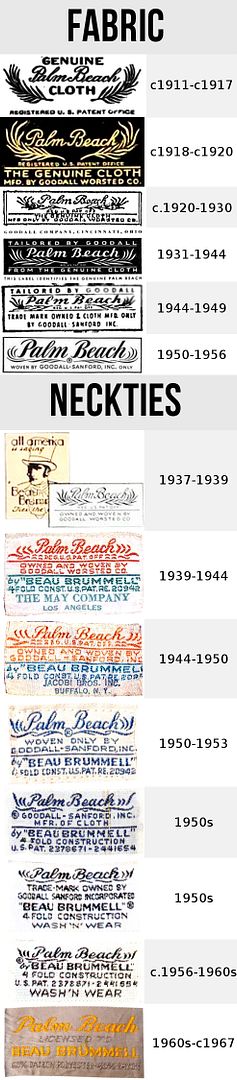
 photo guide.jpg

History

Goodall Mills of Sanford, Maine was founded in 1847. They introduced Palm Beach cloth in 1911. The iconic white variety of the fabric was immediately adopted in the South, but took some time to catch on in Northern states. By 1923, Palm Beach cloth was being produced in more than 140 colors and patterns. (source) Darker colors proved more popular with Northerners who wanted the cool fabric without attracting undesired sartorial attention. Within the first decade of production, soundalike imitation fabrics had started to pop up and “Palm Beach” had become the layman’s term for a light colored suit.

In 1931, a second plant opened in Cincinnati, and the company headquarters relocated to that city. In that same year, the Goodall Worsted Co. organized the Goodall Co., Inc. to “manufacture all garments made of Palm Beach cloth for the 1932 season”. (source) Up until that point, the quality and cost of suits made of Palm Beach cloth had varied wildly. That plant was bought out in 1942, and retooled for the war effort. Despite this, the company headquarters remained in Cincinnati. With control over the fabric and tailoring, Goodall Mills began opening their own line of Palm Beach stores, to sell direct to the public. (source)
In 1944, the town name, “Sanford” was added to the mill name “Goodall”. By the 1940s, further plants producing Palm Beach Cloth had opened in Boston. (source) In 1949, the clothing branch of Goodall Sanford was renamed to simply the “Palm Beach Company”.

The Maine operation of Goodall-Sanford announced losses in 1949. They began to transfer some cloth production to Cincinnati in 1952. (source)Losses were announced again in 1952, though by 1953, sales were back up. Competitor Burlington Mills bought controlling interest in the Goodall Sanford mills in July of 1954, with the plans of “divesting itself of the cutting (suitmaking) operation”. (source) By November of 1954, Goodall-Sanford sold all four of its fabric mills in Maine, leasing one back with the intention of continuing production of Palm Beach fabric. (source) The suitmaking side of the company and the Palm Beach name (but not the mill) was sold in 1955 to Elmer L. Ward, long time president of the Goodall Sanford company. Palm Beach cloth continued to be produced and advertised through until 1956. In the face of dwindling profits, Burlington Mills (later Burlington Industries) shut down the production of Palm Beach Cloth.(source)

Elmer L. Ward retained control of the “Palm Beach” company until 1979, when he was succeeded by his son, Lawrence Ward. It took nine years to pay off the debt accrued by the company prior to the buyout, but under Ward, Palm Beach went public in 1965. In 1975, the holding company “Palm Beach Inc.” was created, which expanded to include the brands of Varsity Town, Gant, Austin Hill, Evan Picone, John Weitz, Calvin children’s wear, Eagle shirts, Haspel, and Country Set. Elmer Ward passed away in 1982. In 1985, a 62% controlling interest was bought out by Merrill Lynch Capital Markets. In 1988, the Palm Beach name was sold again, to Southport, Connecticut based “Crystal Brands”. (source) The name was re-sold to HMX LLC. In 2010, the Palm Beach brand was merged into the “Austin Reed” name.(source)A year later, HMX re-launched the brand. (source)

Content

The fabric content of Palm Beach Cloth changed a number of times of the course of its production.
1912 – Cotton Warp, Mohair Weft
1941 – Reformulated to make the fabric softer and lighter. Precise content unknown, but likely included the addition of Rayon.
Late 1940s – Cotton, Mohair, Rayon. The precise content depended on the fabric’s application, and the region of the country in which it was sold. For instance, the fabric in a Palm Beach necktie of this era was 50% Rayon – 32% Mohair – 12% Cotton – 6% Nylon.

Pricing

The prices for Palm Beach suits varied wildly up until 1931. Up until that point, Goodall Sanford supplied their Palm Beach Cloth to a variety of tailors who produced suits of varying quality and prices. After 1931, clothing made from Palm Beach cloth was made in-house.

A Palm Beach cloth suit sold for $18.50 in 1934
A Palm Beach cloth suit sold for $15.75 in 1935
A Palm Beach cloth suit sold for $15.75 in 1936
A Palm Beach cloth suit sold for $16.75 in 1937
A Palm Beach cloth suit sold for $17.75 in 1938
A Palm Beach cloth suit sold for $15.50 in 1939
A Palm Beach cloth suit sold for $19.50 in 1942
A Palm Beach cloth suit sold for $19.50 in 1945
A Palm Beach cloth suit sold for $23.50 in 1947
A Palm Beach cloth suit sold for $26.75 in 1948.
A Palm Beach cloth suit sold for $27.50 in 1949.

Neckties

In ’31, The Goodall mills switched over to tailoring all their own products for the most part, and gave the contract to produce neckties to Cohn, Roth & Stiffsen of New York, Franc, Strohmenger & Cowan of New York, and Hewes & Potter of Boston. None produced ties from Palm Beach Cloth in any notable quantity. (source) Cluett Peabody (Arrow Ties) had rejected the fabric.

A 1936 contract with the Weisbaum Bros., Brower Company, Cincinnati (producers of Beau Brummell neckties) gave them the exclusive right to produce Palm Beach Cloth neckties.

Patents found on Palm Beach neckties
RE20942. Issued 1938
2131545. Issued 1938
2378671. Issued 1945.
2441654. Issued 1948.

1940s composition: 53% mohair, 47% cotton

Early ’50s composition, from your tag: 50% Rayon, 32% mohair, 13% cotton, 5% nylon.
I’ve seen another from that era marked 50% Rayon, 32% Mohair, 12% Cotton, 6% Nylon.

It looks like by the ’50s “Wash and Wear” Palm Beach ties by Beau Brummel had been re-formulated again to be:
55% dacron polyester, 40% Rayon, and 5% Polyester. I’m seeing ads for those in the late 1950s. Oddly, the tags still say “woven only by Goodall Sanford”, despite the name “Palm Beach” and the Goodall Sanford mills splitting ways around 1955. It was sort of a gradual split, ’54-’56. In the early ’50s, some of the fabric production had moved from Maine to Ohio. I wonder if that included the fabric used in their neckties?

By the ’60s, Beau Brummell Palm Beach ties were 60% polyester, 40% rayon

Blue Resistol cowboy hat

http://www.ebay.com/itm/271138169838

This cowboy hat, made by Restistol, probably in the 1980s, is very close to the classic cowboy hats of the 1920s and 1930s, with its tall crown, Tom Mix crease, and pencil curl brim edge.  It is a navy blue fur felt, with a two cord hat band.  It was sold by “The Maverick”. with locations in Tempe, Chandler and Casa Grande Arizona.  The model is the “Tempe Diablos”, presumably made for members of the charity.
Size: 7-1/4
Brim Width: 4″    PhotobucketPhotobucket

Photobucket

Photobucket

Photobucket

Photobucket

Photobucket

Photobucket

Photobucket

Photobucket